
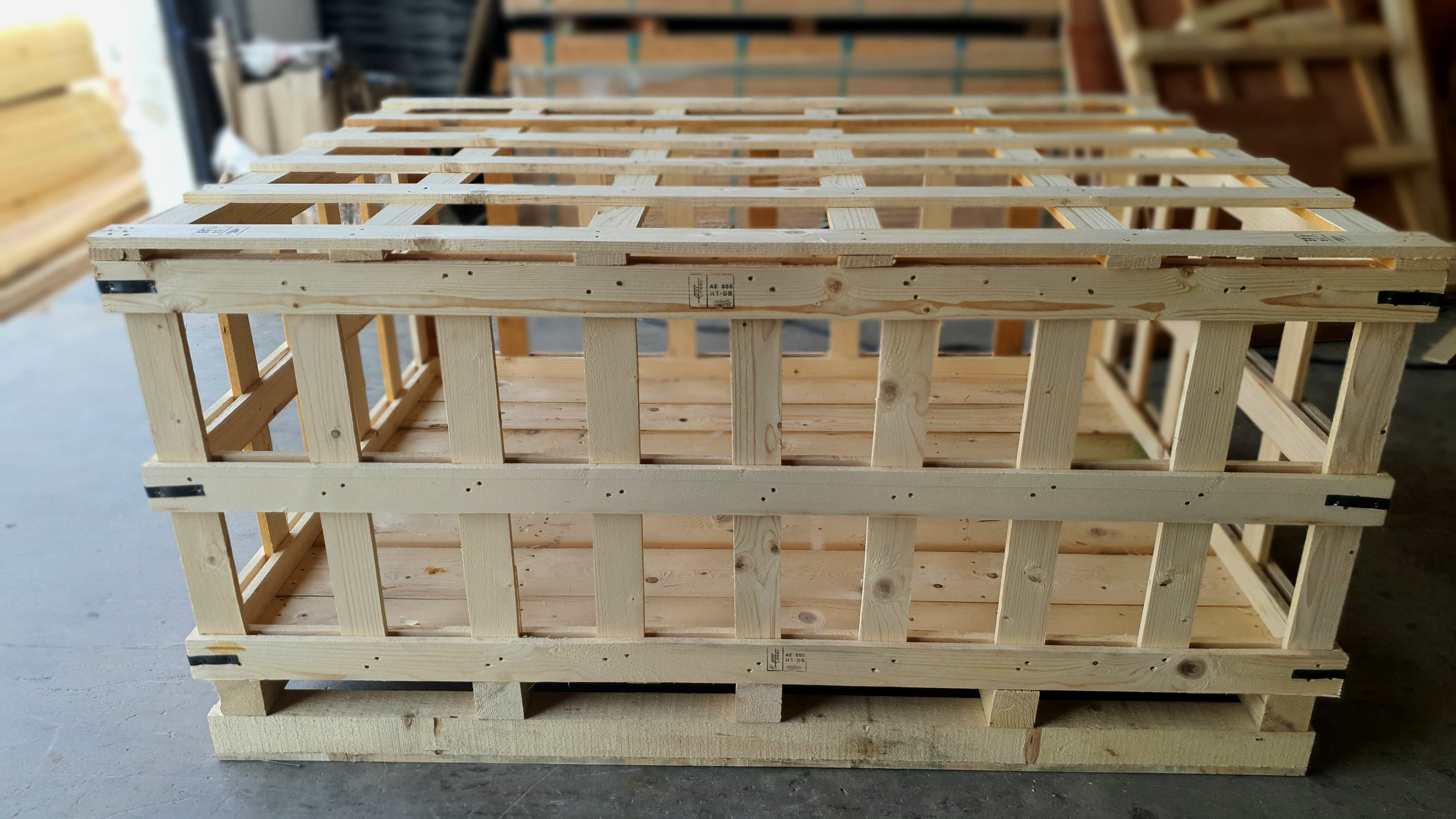
Walk into most export packaging yards in the UAE and you will see the same thing: wooden crates built like small buildings. Six-inch solid lumber where four would do. Steel banding on top of corner braces on top of full plywood sheathing. Fifty kilos of timber wrapped around a twelve-kilo valve. Everyone has the same reason — better safe than sorry. But the data on heavy cargo packaging says the opposite of what most procurement teams assume. Over-engineered crates do not meaningfully reduce damage. They quietly inflate your freight bill on every shipment, and with UAE container rates where they are right now, that bill has become impossible to ignore.
The "Better Safe Than Sorry" Math Does Not Add Up
Packaging Digest reports that up to 11% of unit loads arriving at distribution centres show some degree of damage, with the full range landing anywhere from 2% to 21% depending on industry and geography. Conner Packaging, citing broader industry data, puts the economic cost of in-transit damage at around 0.5% of gross sales, roughly $1 billion a year in the US alone. What that data does not say is that shippers who lose cargo are the ones who under-packed. The research consistently identifies packaging design, not packaging volume, as the root cause of in-transit damage. ISTA has documented that validated, test-driven packaging can cut damage rates by up to 30%. The reduction comes from designing for the actual forces in the transport environment, not from adding more wood. A 45-ton skid of drilling equipment with undersized cleats and poor load distribution will fail on a rough port lift. The same equipment in a crate with half the lumber but engineered cleat geometry and load paths that respect the centre of gravity will arrive at the jobsite intact. Weight is not what protects heavy cargo. Engineering is.
Why "Add More Wood" Feels Safe Even Though It Is Not
If over-engineering does not help, why is it the default in almost every packaging yard in the UAE? Because it is an easy decision to defend after the fact. If a crate fails and an investigation shows the wood was thin, the packer takes the blame. If a crate arrives fine but was twice as heavy as it needed to be, nobody notices, because nobody ever sees the freight bill broken out against the packaging spec. The cost is real. It is just distributed. Every extra kilo of crate timber pays ocean freight, port handling, inland trucking at both ends, fumigation, customs weight-based fees, and in the case of air freight, a severely punitive chargeable weight calculation. None of that shows up on the packaging line item. It hides inside "logistics."
What Chargeable Weight Really Does to Your Freight Bill
Ocean and air carriers do not charge you for what your cargo weighs. They charge you for whichever is greater: actual weight or volumetric (dimensional) weight. DHL Global Forwarding documents it clearly. Volumetric weight for ocean freight is length × width × height in metres, giving you cubic metres (CBM), and the industry standard ratio is 1 CBM equals 1,000 kg. Whichever is higher between the actual weight on the scale and the volumetric weight, that is what you pay for. For heavy cargo, this cuts both ways. A dense valve package will almost always pay on actual weight. But if you wrap that same valve in an over-sized crate with thick walls and a generous internal void, you have done two expensive things at once: pushed up the actual weight with extra lumber, and pushed up the volumetric weight with extra dimensions. An automotive lighting manufacturer profiled in packaging optimisation work achieved a 40% freight expense reduction purely by redesigning cases to remove internal air. A BoldtSmith Packaging Consultants case reported a 25% reduction in freight cost and 46% reduction in packaging material cost after ISTA-validated redesign. Packsize studies of right-sizing found an average 40% reduction in package size and 26% less material consumption. Those are consumer-goods examples. The principle is identical for heavy industrial cargo — the absolute dollar numbers are just bigger because heavy cargo crates are bigger.
The UAE Freight Environment Makes This Urgent
If any of this sounds like a nice-to-have, look at the rates UAE exporters are paying right now. Following the Red Sea diversions and the Strait of Hormuz disruptions earlier this year, carriers have added war risk surcharges of $1,500 to $4,000 per container on top of base rate increases. Vortex Shipping’s analysis puts total shipping cost increases on affected routes at 125% to 180% compared to pre-disruption baselines. Gulf News reports tanker earnings on key crude routes up 467%. Port congestion at Sohar and Salalah is forcing premium repositioning charges on empty containers. In a normal freight environment, the cost of an extra 200 kg of unnecessary crate lumber per project cargo piece is annoying. In this environment, across a year of shipments, it is the difference between winning and losing bids. Every kilo you ship is bought at a rate that is effectively doubled. Most procurement teams have not updated their packaging specs to reflect this. The spec sheets we see at client intakes are still the ones written in 2019, when ocean rates were a third of what they are now.
What Engineered Right-Sizing Actually Looks Like
Right-sizing is not the same as "make it smaller and hope." It is the opposite: making smaller work because you have done the engineering to know it will. When we engineer a crate for a piece of heavy cargo leaving the UAE, four inputs drive the design. First, the cargo itself: weight, centre of gravity, contact points, fragile zones, lifting points, and thermal sensitivity. The crate is designed around these, not around generic templates. Second, the transport environment: container sea freight, breakbulk, roll-on/roll-off, or air — each has its own shock, vibration, and handling signature, and they are not interchangeable. Third, material selection — this is where the over-engineering instinct does the most damage. Plywood has the highest strength-to-weight ratio of any common wood-based material. A properly designed plywood-sheathed crate with engineered cleats is routinely 20 to 30% lighter than its solid lumber equivalent while providing equal or better load distribution. For the oil field stream specifically, mixed-material designs using plywood panels on a steel-reinforced base frame outperform pure-wood designs on both weight and lift handling. Fourth, lashing and lifting integration — the piece most packaging companies skip and most shippers pay for twice. If your crate is designed without thinking about how it will be lifted, lashed to the deck, and secured inside the container, you will either end up adding extra external bracing on-site (which adds weight and cost and is usually unengineered) or you will have an incident. And all of it sits on top of ISPM 15 compliance from the start: debarking, heat treatment to a core temperature of 56°C held for at least 30 minutes, and the correct compliance mark burned into the wood.
A Simple Check You Can Do Before Your Next Shipment
If you are a procurement manager or logistics head wondering whether your current packaging spec is carrying a hidden cost, there is a quick audit worth doing before your next heavy cargo export. Pull the packing list for your last three project cargo shipments out of the UAE. For each piece, note the cargo weight and the total packed weight. Calculate the ratio. If your crate weight is running more than 15 to 20% of your cargo weight on dense heavy equipment, you are almost certainly over-packaged. On denser items like valves, pumps, compressors, and manifolds, the right ratio is usually lower than that. Then look at the dimensions. If your crate has more than about 100 mm of internal void on any side beyond what is needed for blocking and dunnage, you are paying volumetric weight for air. At current chargeable weight rates out of the UAE, air is the single most expensive thing you can ship. Neither of these checks requires engineering training. They just require looking at numbers most teams have never been asked to look at.
The exporters who figure this out in the next twelve months will have a meaningful cost advantage on heavy cargo and oil field contracts across the GCC. The ones who keep defaulting to "better safe than sorry" will keep paying for air. If the ratio is wrong or the void is there, the fix is an engineered redesign built specifically around your cargo, your destination, and the route your project cargo takes out of the UAE. That is the work. It is not glamorous, but the savings show up on the first shipment and compound on every one after that.